
The Enduring Brilliance of Alfred Hitchcock's Vertigo
The sick genius of Vertigo is Hitchcock giving us beauty, then forcing us to admit the violence we may do to preserve it.

Most movies clamor to be watched. Alfred Hitchcock's Vertigo demands to be worn. Not with sneakers, in pajamas, and not with ripped denim or your favorite band t-shirt. You don’t throw Vertigo on while folding laundry or half-watching on a cracked iPad while eating leftover noodles over the sink. Absolutely nope.
Much like a proper magical operation or a marriage made in heaven, Vertigo is one of those rare objects of cinema that demands ceremony. Dim the room. Burn something that smells nice. Pour something brown into a sturdy glass, even if, as the protaganist says, it's "A bit early in the day for spirits."
This will be a slow burn, like eating a full artichoke with melted butter. Put your phone in another room like it has wronged you personally. Sit down and submit.
Alfred Hitchcock made a ghost story without a ghost, a love story without love, and a detective movie where the detective inadvertently investigates the mildew in his own soul. That’s the Hitchcockian sleight of hand.
Everyone says Vertigo is about obsession, which is true in like saying a thunderstorm is about rain is true. Sure. Rain is involved. But the real business is pressure, charge, the air suddenly reeking of ozone before the sky opens.
The Plot
Overview time. Hitchcock favorite son Jimmy Stewart plays Scottie Ferguson, a retired San Francisco detective with a fear of heights and the general expression of a man with a faulty item who has just been told the universe has no customer service department. He is hired, reluctantly, to follow Madeleine Elster, played by Kim Novak, who appears less like a woman than an apparition with bespoke tailoring. Gray suit. White-blonde hair. Green light. A face that seems to have been assembled by candlelight and Venusian intentions.
This is where Hitchcock starts cooking with poison.
Scottie follows Madeleine through San Francisco as if the city itself has become a puzzle box built by a jealous god. The flower shop. The mission. The museum. The graveyard. The Golden Gate. Nobody trails a woman like Scottie trails Madeleine. Surveilance? Noe. Worship with a gas tank. Every turn of the steering wheel says, “I am losing my mind, but at least the car is nice.”
And the clothes. Goodness, the clothes.
Edith Head’s costumes do the kind of work most scripts can only beg for. Madeleine’s gray suit is not just chic. It is a prison uniform for a fantasy. The black gloves, the sculpted hair, the little bouquet, the severe lines. She looks expensive and elegant in the way an ornate gate welcoming you to the Biltmore House looks expensive.
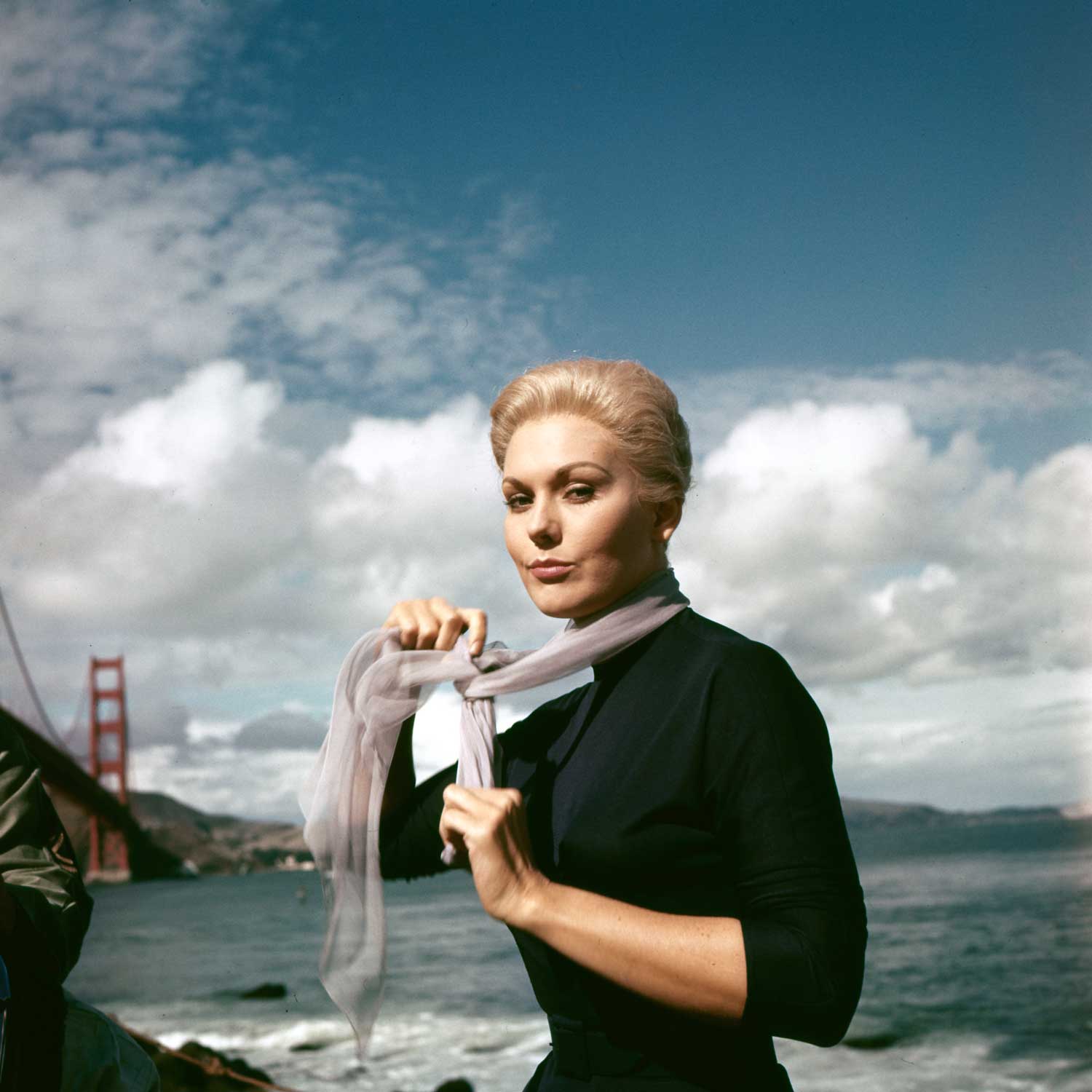
Later, when Judy (re)appears in her green dress and muted brown hair, the whole movie changes texture. Suddenly the dream has a zipper. Suddenly the saint is chainsmoking in a hotel room and wondering how much longer she can keep pretending not to be human.
The sick genius of Vertigo is Hitchcock giving us beauty, then forcing us to admit the violence we may do to preserve it.
Scottie doesn’t love Judy with sovereignty. He wants to reupholster her. He wants to sand her down, bleach her, dress her, pin her hair into a spiral, and drag the dead woman back out of her living body. It is one of the nastiest romantic sequences in cinema. And possibly one of the most honest, famously reflecting Hitchock's own fraught relationship with the starlets who make his films come to life. He posits that obsession is rarely wild at first. It begins with taste. With preference. With “not that dress, the other one.” With “wear your hair this way.” With “I liked you better when you were impossible.”
Hitchcock understood the horror of curation before we had feeds. Scottie is the original man arranging a moodboard and calling it love.
And Kim Novak. Let’s talk about Kim Novak, because the movie’s soul lives in her face.
She is often described as mysterious, which is the laziest possible read. She is not mysterious. She is cornered. Watch her eyes. Watch the little freezes, the flinches, the way hope rises in her and gets strangled before it reaches her mouth. As Madeleine, she is all lacquer and mist. As Judy, she is ache in department-store lighting. When Scottie begins remaking her, Novak does something almost unbearable: she lets us see Judy agreeing to her own erasure because being loved badly still feels better than not being loved at all.
Is that mystery? Nah, that’s tragedy in a cheap hotel mirror.
Bernard Hermann’s score haunts the film. The music circles and climbs and collapses, like thick perfume trapped in an elevator. It has that narcotic, sea-sick pull, the sound of wanting something you already know will ruin you. The opening credits prepare you for this: a woman’s eye, spirals, color, dizziness. It’s less an introduction than a warning label.
Do not operate heavy machinery after viewing.
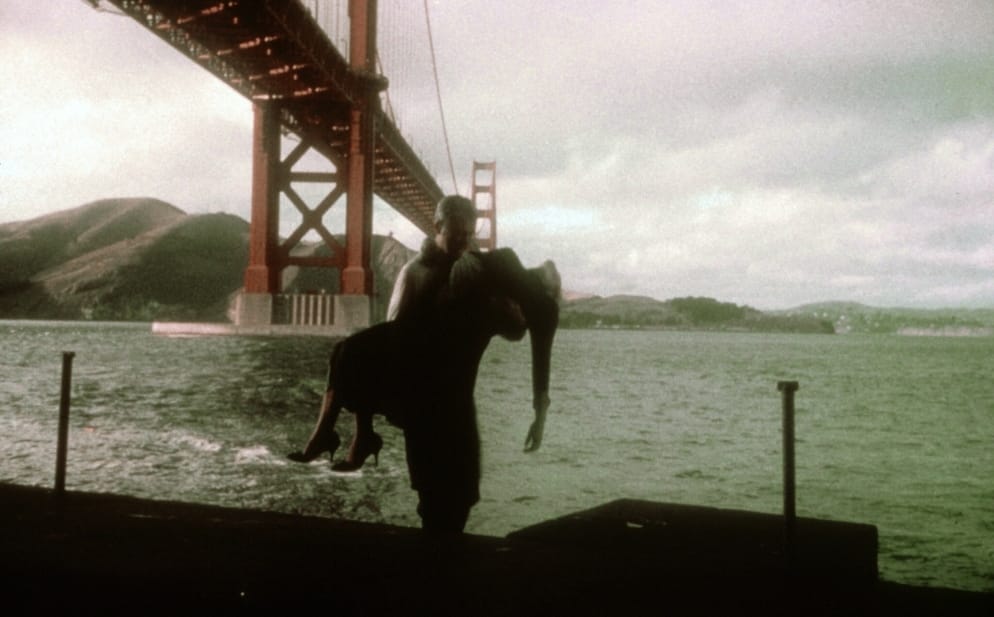
San Francisco has never looked more cursed or more desirable. Hitchcock shoots the city like a place where the buildings remember your sins. The hills are accusations. The bay glitters like a polished knife. Even the daylight feels suspicious. There is a reason the film keeps returning to towers, staircases, windows, ledges. Upward movement in Vertigo is not aspiration. It is a dare from death.
People love to call this Hitchcock’s masterpiece. Fine. Let them. It is. But “masterpiece” is too clean a word for what this thing does. Vertigo is a beautiful coat draped on a Barcelona chair with bloodstained lining. It is elegant, deranged, controlled, feverish. It has the manners of a classic and the bloodstream of a stalker.
The shocking twist is almost beside the point. The real shock is how early the film sees through the lie that fantasy is harmless. Fantasy has hands. Fantasy buys clothes. Fantasy books hotel rooms. Fantasy says, “Just one more change and then I can love you correctly.”
There are movies that get older and become homework. Vertigo gets older and becomes more dangerous. You watch it once and think: poor Scottie, haunted by love.
You watch it later and think: run, Judy.
You watch it after that and think: I could be Scottie. I could be Judy. I have mistaken longing for fate. I have dressed up emptiness and called it devotion. I have looked at a person and seen not a human, but an altar.
That is why the movie still bites.
Hitchcock knew that human beings are terrifying when they are misleading themselves, in this case certain they are being romantic. Vertigo is the crown jewel of that dark little kingdom: a film about the erotic pull of doom, the vanity of grief, the cruelty of taste, and the terrible glamour of wanting the dead to come back exactly as we imagined them.
It is gorgeous. It is sick. It is perfect.


